TriplePundit • Can Renting Baby Gear Fix a $4.5 Billion Waste Problem?
For decades, the dominant narrative around baby gear has centered on ownership and novelty. Parents are told they must buy the right stroller, the right swing, the right bassinet — often before their child is even born. The result is tons of short-lived products piling up in homes and landfills.
Parents in the United States discard about 100 million kids’ and baby items each year estimated to be worth around $4.5 billion, according to the online peer-to-peer marketplace Mercari.
Reuse systems do exist, like ”buy nothing” groups on Facebook, consignment stores and peer-to-peer swaps, but they don’t always fit the needs of exhausted and overwhelmed parents. “If you want to use buy nothing groups in a place like Facebook Marketplace, there’s a lot you don’t know,” said Philadelphia-based entrepreneur and Baby Gear Group founder Bo Zhao. “Is this item recalled? Is there a piece missing?”
Baby gear is particularly well-suited for reuse because most items are only relevant for short windows of time before a child grows and moves on. But the consumer industry for baby products functions heavily on the emotional pressure of buying the “right” products for your child.
Zhao experienced this firsthand when she became a mom. “I could feel the marketing being very predatory,” she said. “Tapping into these emotions of, ‘You’re not going to be a good mom. You’re not going to be prepared unless you have the thing.’”
She ended up with gear her child never used or quickly outgrew. “Half the stuff you never use, the other half you use, but it’s only relevant for a short period of time,” she said. “It becomes clutter in your home.”
American families collectively own over 868 million kids’ and baby items worth $39.6 billion, with about 31 percent of those items no longer used or never used, according to the Mercari report. That translates to $13 billion worth of potentially resalable goods at home.
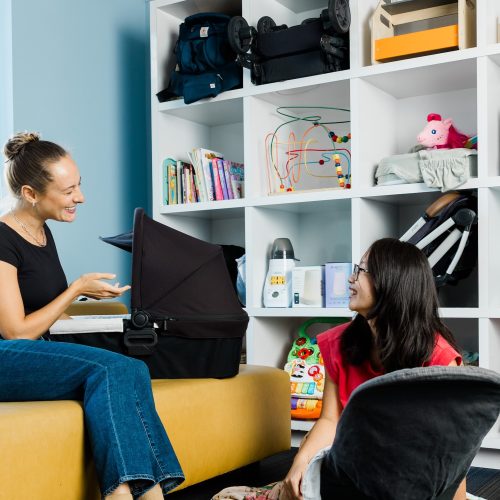
Having worked in e-commerce and supply chain management, Zhao was familiar with the environmental toll behind these products, from the pollution at manufacturing facilities to the waste that accumulates in landfills. That insight led her to create Baby Gear Group, a B Corp-certified lending library that allows parents to borrow baby items like bassinets, toys, strollers and travel supplies instead of buying them.
Families can pay a membership fee to borrow multiple things at a flat rate or rent items individually. They use it for as long as they need. Then, the company picks up the used gear, vets it for safety, professionally cleans it, and delivers it to the next borrower. Families can easily swap items to meet their needs as their babies grow. And Baby Gear Group guarantees that parents will never pay more in rental fees than half of the retail value of the items they rent.
The B Corp recently earned a spot on Time Magazine’s Best Inventions of 2025 list for its potential to reduce waste and cut costs. According to Zhao’s customer surveys, parents cite both sustainability and cost savings as their top motivations for using the service. Others come for the simplicity, especially as they realize how quickly babies cycle through gear.
“Some people are wary of used products for their precious babies, which I totally understand,” Zhao said. “Then three months in, you’re like … ‘I’ll try the swing … the magical thing that will make my life easier.’”
Building a community through sharing addresses another challenge that often goes unspoken: the isolation many new parents feel. Zhao talks directly with many of her customers and hosts baby clothing swaps in partnership with public libraries, child-care centers and sustainable stores. “A lot of communities have lost that sense of village,” she said, referring to the proverb used to describe the support networks behind raising children, “It takes a village.”
Parents say these touch points matter. “In a world of excessive consumerism, and considering how expensive it is to raise a baby, these spaces are a huge lifeline for us and a window into a different way of life,” a parent who attended a Baby Gear Group clothing swap before giving birth said in a customer survey.
Another parent shared how the rental service reduced the overwhelm of early parenthood. “She gave us peace of mind, so we could focus on the health and progress of our babies instead of worrying about supply chain issues and not being home for deliveries,” they wrote in a survey. “As first-time parents, this service prevents you from registering for or buying something that you end up using only once (or not at all!).”
The company intends for the system to be replicable in many communities. It’s currently operating in nine cities across the U.S. and growing through licensing agreements that allow local operators to open Baby Gear Group branches in their communities.
The long-term goal is opening 1,000 branches across the U.S., which Zhao estimates could divert 24 percent of baby and kids’ gear waste and collectively save families around a billion dollars. “There must be other people out there who also want to do this for their communities,” she said.
Zhao is quick to note that having a real impact doesn’t require every parent in a community to participate. Instead, the system gives parents who already value reuse a way to act on those values, without the added labor of navigating secondhand marketplaces. “Small problems in your community are worth solving,” Zhao said.
In tackling one small but pervasive problem, she’s shown how local solutions can challenge systems born out of consumerism and societal pressure, and reshape them into ones with sustainability and community at their core.


Post Comment