Design Of Common Emitter Amplifier
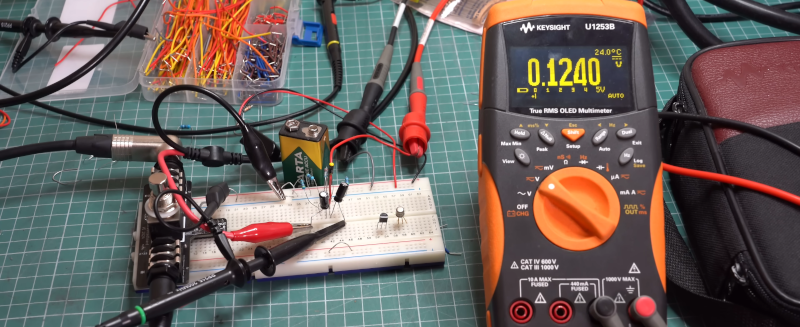
It used to be a rite of passage to be able to do the math necessary to design various bipolar transistor amplifier configurations. This doesn’t come up as often as it used to, but it is still a good skill to have, and [Void Electronics] walks us through a common emitter amplifier in a recent video you can see below.
The input design parameters are the gain and the collector voltage. You also have to pick a reasonable collector current within the range for your proposed device that provides enough power to the load. You also pick a quiescent voltage which, if you don’t have a good reason for picking a different value, will usually be half the supply voltage.
The calculations are approximate since the base-emitter voltage drop will vary by temperature, among other things. But, of course, real resistors won’t have the exact values you want, or even the exact value marked on them, so you need a little flexibility, anyway.
There are other ways to approach the design. But most design guides will make the same assumptions: Ic=Ie, base current is negligible, and similar simplifying assumptions.
At the end, the circuit winds up on a breadboard so you can see how close the predicted performance is to the design.
We’ve covered biasing bipolar devices a number of times. We’ve even modeled circuit variations in a spreadsheet.



Post Comment