TriplePundit • E-Bikes Revolutionize Rural Transportation and Empower Women in Zimbabwe
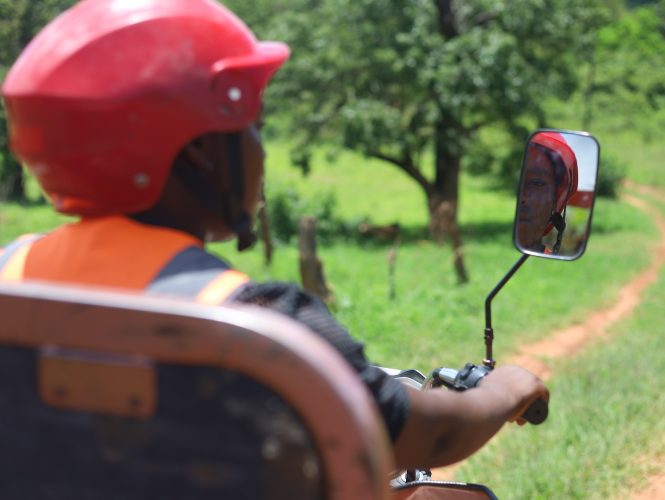
As the morning sun emerges after a night of relentless rain, Rudo Munguma is making her third delivery of fresh farm produce to Hauna Center, a rural commercial center in Eastern Zimbabwe.
She transports bananas, avocados, tomatoes and cabbage in the cargo section of an electric tricycle through rugged roads from farms to the district’s center located within a predominantly agricultural community that’s a 4-hour drive from Zimbabwe’s capital, Harare. From here, farmers can easily transport crops to markets in other cities because the road is tarred, unlike the difficult-to-traverse roads in the rural areas where the crops are grown.
Munguma is one of the dozens of women from this community who were given the e-tricycles to ease transport woes. Some are farmers who use them to transport fresh produce from their farms. Others are hired to do so by farmers.
A combination of steep terrain, narrow and neglected roads makes it hard to navigate deep into the rural areas. The e-tricycle, traveling at low speeds of 20 kilometers per hour (12 miles per hour), can easily navigate those conditions due to its small size.
To these women, owning an e-tricycle means empowerment and independence. “I have realized that couples fight a lot here when a woman is not working. When she is working and bringing money to the table, there is peace,” Munguma told TriplePundit while sitting beside her son at her home in Mapeza village. “I earned respect from my husband since the day I started working.”
Using profits from her small transport business, the 31-year-old helped her husband build their seven-room house. She also helps buy essentials for their two children, including paying for school fees, stationery, clothes and food.
Established in May 2024 by Mobility for Africa, a startup offering green mobility services to rural communities, the e-tricycle initiative began with approximately 20 women. The number has since increased to 35 women and 10 men.
Known as Hamba, a Shona name that loosely translates to “go” in English, the e-tricycles are powered by lithium batteries. A fully charged battery covers a distance of up to 100 kilometres. Renewable energy is used to charge the batteries because the national grid is unreliable. When a battery is low, the women can swap it for a fully charged one at a charging center in Hauna.
Still, participants are limited to traveling within a 35-kilometer radius so technicians can follow up if there are any issues with the tricycles, like breakdowns or dead batteries.
The initiative focuses on women to reduce the burden of carrying farm fresh produce to the market by hand, said Skhangezile Dube, Mobility for Africa Hauna site coordinator. “Our goal is to help women. We are serving the last mile, meaning our Hambas come in at the last point reached by buses,” she said, sitting in her office near a group of women who came to charge their e-tricycle batteries. “Women and girls bear the burden of carrying farm produce on top of their heads. They also carry inputs like seeds and fertilizers. We are reducing this burden.”
The idea is for these women to be self-sufficient, Dube said. “We want them to earn money,” she added.
Munguma, one of the pioneers of the program, was given the e-tricycle at zero deposit. The agreement was that she would pay $10 per day to Mobility for Africa for one year in return. This fee includes e-tricycle servicing and battery swaps at the Hauna site. On a good day, Munguma said she makes $30 shuttling produce.
As the midday sun intensified, Christine Mutsveta from Muparutsa village ran errands with her tricycle at the Hauna Center. It was hard to carry a reed basket of tomatoes on her head when growing up, she recalled. “I remember feeling pain in my neck and back after carrying vegetables,” Mutsveta said while removing a customer’s goods from the cargo section of her e-tricycle.
Mutsveta is also one of the e-tricycle pioneers who started in May 2024. As a farmer herself, she volunteered when Mobility for Africa called for applications.
Mutsveta said she was excited when her application was successful, but the excitement quickly faded as fears about riding the e-tricycle set in. “It was my first time riding an e-tricycle,” she said. “I was scared, but the fear went away after a few trips.”
Each participant spent two weeks in training to learn how to safely ride the bikes. Now, Mutsveta uses the tricycle to ferry fresh farm produce and groceries for a fee, which is determined by weight and distance. “I get about $25 daily,” Mutsveta said, pointing to her Hamba. “My life has changed since I started working. I am now a breadwinner.”
Still, there’s room for improvement. The women bemoaned the lack of spare parts for the Hambas, forcing some to park them after they developed mechanical faults. Most of the batteries are frequently dead, making it difficult to swap batteries.
“There are not enough batteries at the site. If my battery is being charged, I wait for it. This means that I lose customers to our competitors,” Mutsveta said. “I am not comfortable because of spare [parts]. If my Hamba develops a mechanical fault, I am forced to park it because there are no spares.”
The initiative needs more energy at its sites and more batteries to address the problems participants are facing, said Shantha Bloemen, founder of Mobility for Africa. “It has been a difficult year for us,” she told 3p. “When we first started, we didn’t really appreciate the battery ratio we needed. We now agree that we need two batteries per tricycle, so we can swap. And we need enough energy, which we can use to charge those batteries.”
The team is also aware of, and hopes to address, the lack of spare parts. “We have a lot of lessons, and we need financing to fix those problems,” Bloemen said. “We have a new version of the tricycle coming but with all new parts.”
It is difficult to convince banks that rural women in the informal sector are bankable, Bloemen said. “It’s been impossible within Zimbabwe to find any financing, and if you can find it, it is expensive,” she added.
Despite the challenges, the initiative has been replicated across the country.
Back in Hauna, Munguma, a dressmaker by profession, dreams of diversifying her business and seeing more women and girls in the transport sector, so they can experience the same independence. “I want to open a shop and sell baby wear as another stream of income,” she said. “I would also want to see more women and girls getting Hambas in other rural areas.”



Post Comment