TriplePundit • A Fragile System is Taking Shape to Manage Nigeria’s E-Waste Crisis
In October 2012, Yusufu Asabe’s daily routine began with picking up a sack and a narrow iron rod. Dressed in a rough T-shirt and shorts, he walked toward an electronic waste dumpsite in Ojo, Lagos State, rummaging through piles of discarded phones, radios, computers and game consoles in search of anything he could sell. He was 11 years old.
Like many young migrants drawn to one of Africa’s largest economic hubs, Asabe left Sokoto State in northwest Nigeria in search of work. Trained as a cobbler, he found few opportunities. Scavenging electronic waste, often from open dumps and clogged drainage channels, became his means of survival.
“Picking e-waste is not easy,” Asabe said. “It’s laborious. Sometimes we go days without bathing because of the stress.”
That’s changing as local collectors and recyclers work together to popularize safe handling practices in semi-formal recycling systems and the Nigerian government collaborates with large companies on extended producer responsibility.
A growing environmental threat
Illegal e-waste dumping is one of the most serious environmental threats in Sub-Saharan Africa. Weak waste regulation and the continued importation of used and obsolete electronics have polluted waterways, soil and air across the region. Nigeria and Ghana are the largest recipients of e-waste in West Africa.
Nigeria generated over 1.1 billion pounds of e-waste in 2022, none of which was documented as formally collected, according to the Global E-Waste Monitor. Most of this waste is dumped or openly burned at informal sites, releasing lead, cadmium, brominated flame retardants and microplastics into the environment, contaminating soil, rivers and nearby communities.
The problem is escalating globally. The world generated more than 68 million tons of e-waste in 2022, yet only 22 percent was formally recycled. The remainder ended up in landfills or informal dumps, exposing millions to hazardous substances. Research shows that children and pregnant women are particularly vulnerable to toxins released from electronic waste.
“Lead and cadmium have no biological value,” said Michael Odey, an environmental toxicologist at the University of Calabar. “There is no safe level of exposure. They are toxic at all concentrations.”
Doing things differently
Asabe, now 22, no longer scavenges for e-waste at dumpsites. Instead, he operates within a semi-formal chain linking phone repairers, middlemen and recycling companies.
At Alaba International Market, one of West Africa’s largest electronics hubs, Asabe and other informal collectors move from kiosk to kiosk, clanging phone panels together to announce their presence. They buy damaged phone panels and condemned devices from repairers, paying between 500 and 1,000 Nigerian naira per item (US$0.35 to US$0.68).
“We only buy buttons and Android phone panels or condemned phones,” Asabe said. “We resell them here.”
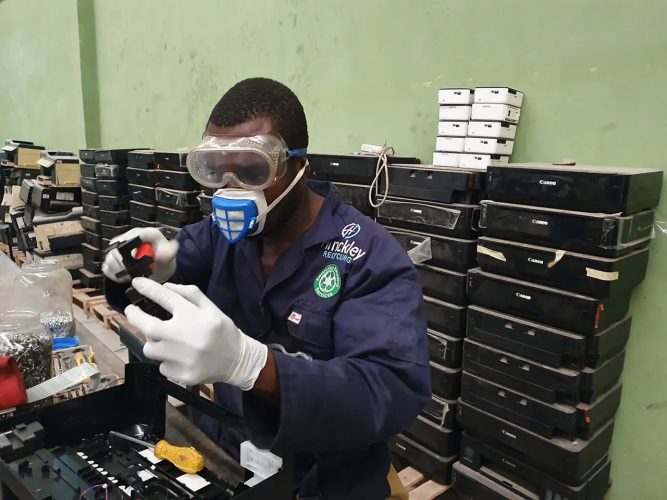
One of the buyers is Chukwuma Samson, a 45-year-old e-waste merchant and agent of an accredited recycling company. Samson was trained by Hinckley Recycling, a Lagos-based recycler, on safe handling practices and the use of protective equipment. He has since trained more than 30 informal collectors on basic safety measures, such as wearing gloves and face coverings while handling electronic waste.
The shift has reduced exposure to hazardous materials for those who participate, Samson said. Collected waste is aggregated, weighed and transported to recycling facilities rather than burned or dumped. By consolidating waste at the market level and routing it to licensed facilities, the model reduces the need for informal burning and dismantling, which are the primary sources of toxic emissions from e-waste.
While comprehensive national data on e-waste diversion remains limited, recyclers operating in Lagos say thousands of devices and components are now aggregated and processed each month through semi-formal channels that did not exist a decade ago. The volume represents only a fraction of Nigeria’s total e-waste output, but it marks a shift away from open dumping and burning in some of the country’s largest electronics markets.
National interventions
While Europe’s e-waste is largely processed through regulated recycling systems, and Rwanda operates a centralized facility processing roughly 11,000 tons annually, Nigeria relies predominantly on informal collection and dismantling. The creation of the E-waste Producer Responsibility Organisation of Nigeria in 2018 marked an effort to introduce an extended producer responsibility framework into a largely unregulated system, shifting responsibility for end-of-life electronics to manufacturers and importers.
In 2019, the Nigerian government, with support from the Global Environment Facility and United Nations Environment Program, launched a $15 million initiative aimed at reforming the sector, reducing pollution and creating safer waste management systems. It’s using legislation and business development support to encourage electronics producers to take responsibility for their products from production through disposal and recycling.
“Support from private-sector actors like HP, Dell, Philips, Microsoft and Deloitte has been critical,” Ibukun Faluyi, EPRON’s executive secretary, said in a 2023 interview.
Environmental experts say the approach could be replicated in other Nigerian cities where electronics markets dominate the waste stream, but only if financial incentives for collectors improve and enforcement becomes more consistent. Without those conditions, safer recycling risks remaining limited to pockets of activity, rather than transforming the system nationwide.
Unresolved challenges
Despite progress, the system at Alaba International Market remains fragile. Middlemen like Samson can earn more than 200,000 Nigerian naira (US$137) per month, while informal collectors often complain of low prices and unequal bargaining power. Some still prefer scavenging at dumpsites, where buyers pay by weight, despite higher health risks. Regulatory enforcement also remains weak.
“Nigeria has guidelines for e-waste treatment and disposal,” environmental toxicologist Odey said. “But enforcement is the major challenge. Without it, eliminating e-waste pollution will remain difficult.”
Nigeria’s e-waste response has not eliminated informal dumping or toxic exposure. But the growing network of recyclers, trained intermediaries and producer-responsibility systems suggests that environmental harm can be reduced when market incentives align with public health goals. The experience indicates that, in countries where informal recycling is deeply entrenched, progress may depend less on replacing informal systems than on gradually integrating them into safer, regulated supply chains.
For young people like Asabe, the shift away from dumpsites has already reduced daily exposure to toxic waste, even as broader environmental risks persist.



Post Comment