Lichtenberg Lightning In A Bottle, Thanks To The Magic Of Particle Accelerators
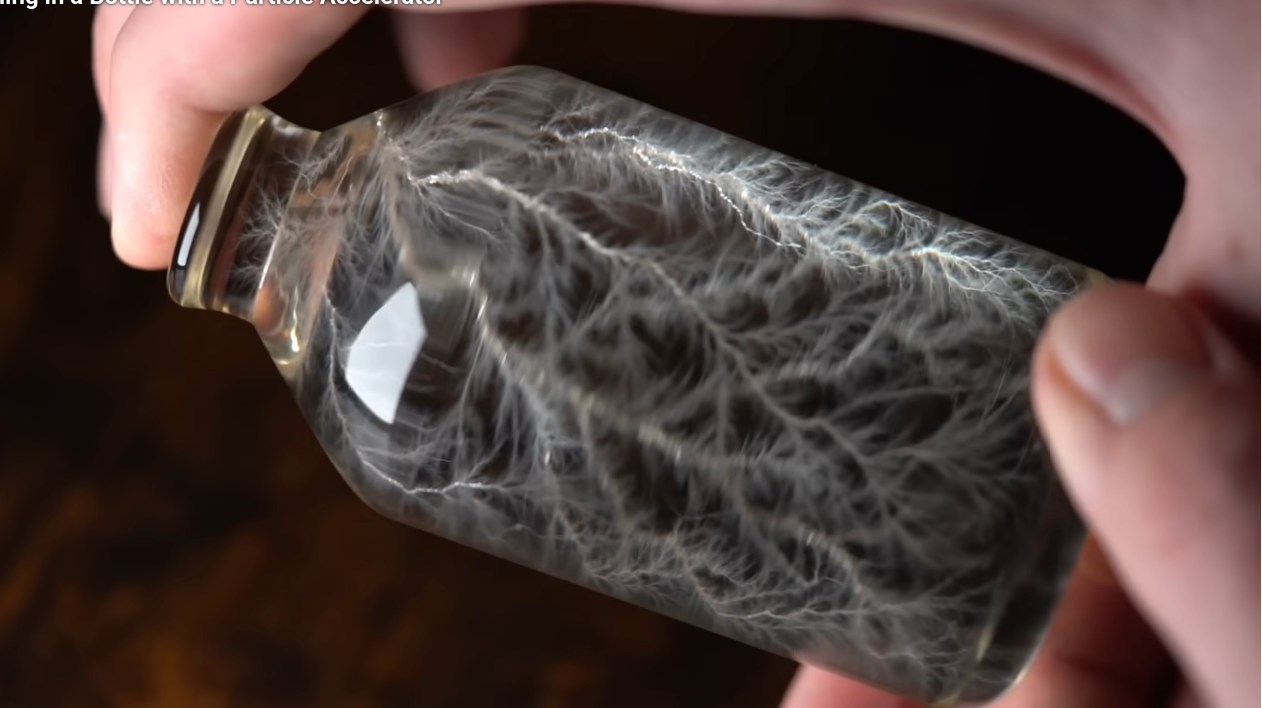
You’ve probably seen Lichtenberg figures before, those lightning-like traces left by high-voltage discharge. The safe way to create them is using an electron beam to embed charge inside an acrylic block, and then shake them loose with a short, sharp tap. The usual technique makes for a great, flat splay of “lightning” that looks great in a rectangular prism or cube on your desk. [Electron Impressions] was getting bored with that, though, and wanted to do something unique — they wanted to capture lightning in a bottle, with a cylindrical-shaped Lichtenberg figure. The result is in the video below.
They’re still using the kill-you-in-milliseconds linear accelerator that makes for such lovely flat figures, but they need to rotate the cylinder to uniformly deposit charge around its axis. That sounds easy, but remember this is a high-energy electron beam that’s not going to play nice with any electrical components that are put through to drive the spinning.
Ultimately, he goes old-school: a lead-acid battery and a brushed DC motor. Apparently, more power-dense batteries have trouble with the radiation. Though the 3D-printed roller assembly is perhaps not that old-school, it’s neat to know that PETG is resilient to beta ray exposure. Getting footage from inside the linear accelerator with a shielded GoPro is just a bonus. (Jump to five minutes in to see it go into the beam chamber.)
The whole process is very similar to one we featured long ago to put Lichtenberg figures into acrylic spheres (the linked post is dead, but the video survives). If you don’t have access to a powerful electron beam, you can still make Lichtenberg figures the old-fashioned way with a microwave sign transformer, but that’s very much an “at your own risk” project, considering it’s the deadliest hack on the internet.
Post Comment