TriplePundit • Nigeria Is Using CNG to Fight Fuel Inflation. What Does That Mean for Its Clean Energy Transition?
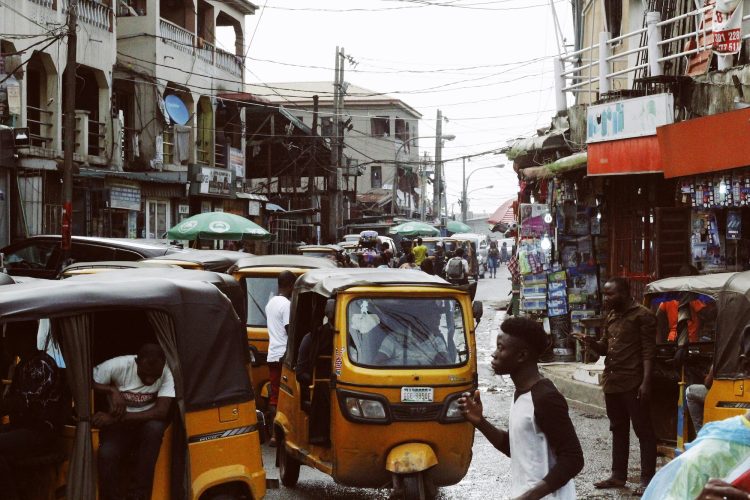
With fossil fuel prices skyrocketing in Nigeria, many commercial drivers are eyeing compressed natural gas, or CNG, as the way out. The reason is explicit: affordability. The country is home to abundant natural gas reserves, and the process of purifying and compressing natural gas to produce CNG is cheap and simple. The low cost associated with local production makes CNG significantly more economical than fuels that are chemically refined and imported from overseas, such as gasoline and diesel.
Fuel cost pressures intensified in May 2023 when Nigerian President Bola Ahmed Tinubu declared in his inaugural address that the country’s long-running petrol subsidy was over. Tinubu argued that the subsidy disproportionately benefited wealthier Nigerians and drained public finances. “We shall re-channel the funds into better investment in public infrastructure, education, healthcare and jobs,” he said at the time.
The announcement landed hard in a country already grappling with high inflation and rising food costs.
Within days, gasoline prices more than tripled, triggering fuel hoarding, long queues at filling stations and transport fare hikes. Fuel scarcity, a recurring feature of Nigeria’s modern era, returned once again, amplifying the economic shock.
Since CNG has a lower cost per mile compared to diesel and gasoline, it helps cut operating costs for commercial drivers like Daniel Ashaolu, a rickshaw driver shuttling passengers in Ilorin, the capital city of Kwara state in western Nigeria. Converting his rickshaw to CNG cost Ashaolu 600,000 Nigerian naira (about US$415) last June, a sum he describes as painful but unavoidable.
“This is a lot of money,” Ashaolu said. “But petrol is expensive. I was pushed to the wall.”
An initiative with climate and cost goals
To cushion the impact of higher fuel prices and address the environmental toll of fossil fuels, the government rolled out the Presidential Compressed Natural Gas Initiative in 2023 — which promotes CNG as a lower-cost, lower-emission alternative for vehicles, particularly commercial transport.
Beyond affordability, the policy is positioned as part of Nigeria’s broader climate commitments, including its pledge to reach net-zero emissions by 2060. Under the program, the government prioritizes subsidized vehicle retrofits for commercial cars, buses, and tricycles operating on interstate and intrastate routes. Officials say switching to CNG can reduce transport fuel costs by up to 50 percent while cutting particulate emissions and local air pollution.
Experts have lauded the initiative, saying it is a positive step forward, particularly as the country faces climate and air pollution challenges. CNG emits less particulate matter, less sulphur oxide (a primary component of smog) and less nitrogen oxide (a potent greenhouse gas), making it cleaner than fossil fuels.
“Compressed natural gas does offer a cleaner alternative within the fossil-fuel spectrum,” said Victor Ejechi, head of Nigeria insights at SBM Intelligence, a geo-political market research consultancy. “Compared to petrol and diesel, it produces fewer particulates, less sulphur and lower local air pollution, which matters in dense urban centers.”
From that perspective, CNG can deliver immediate economic and environmental benefits in countries still heavily dependent on liquid fuels, Ejechi said.
Recent research from Delta State University of Science and Technology and Federal University of Petroleum Resources Effurun found that CNG vehicles reduce carbon dioxide emissions by 29 percent, nitrogen oxide emissions by 70 percent, and particulate matter emissions by 80 percent in the country. Those reductions in air pollution are estimated to prevent hundreds of premature deaths and thousands of hospital visits annually, according to the research.
Early evidence on the road
At Geri Alimi Motor Park in Ilorin, CNG’s impact is already visible. In December, rows of commuters traveling home to celebrate the holidays with their families sat with their luggage, waiting for CNG-powered buses heading to Lagos and Ibadan. During peak travel periods like this, riders often pay lower fare prices for CNG vehicles than for their petrol-powered counterparts.
“Our fares are lower because we use [CNG],” said Tijani Moshood, a local motor park manager. Passengers traveling long distances pay about 10,000 naira (US$7), a rate he says would be impossible with petrol-powered vehicles. Commuters affirmed the cheapness of the CNG fleets.
Over 15,000 private and commercial vehicles in Nigeria have been converted to CNG through the Presidential Compressed Natural Gas Initiative alone, alongside more than 400 new CNG buses and over 700 tricycles, according to the initiative. Several other African countries — including Egypt, Kenya, Tanzania, Equatorial Guinea and Ethiopia — launched similar initiatives, watching Nigeria’s experiment closely.
For drivers like Ashaolu, the savings are tangible. He now spends about 3,700 naira (US$2.50) a day on CNG, compared to the 16,000 naira he’d spend daily on petrol, which doesn’t last as long. He now earns roughly 30,000 naira (US$21) daily driving his rickshaw, close to Nigeria’s monthly minimum wage.
“With petrol, the money finishes quickly,” he said. “With gas, I work without worrying.”
Limits, risks and who gets left out
Nigeria aims to convert 1 million vehicles to CNG by 2027, out of an estimated 11 million on the road, according to the Presidential Compressed Natural Gas Initiative. But analysts warn that bureaucratic delays, limited refueling stations and high upfront conversion costs could slow progress.
Safety concerns also linger among drivers wary of CNG cylinder explosions, while many low-income operators simply cannot afford the conversion fee.
“Rural and semi-urban communities have limited access to CNG stations,” said Emmanuel Kilaso, founder of the Securecycle Environmental and Climate Change Initiative, which advocates for environmental protections. “For many people outside major cities, adoption is impractical.”
Informal transport workers, especially tricycle and motorcycle operators, also face structural barriers, including lack of credit, technical support and regulated conversion systems, Kilaso added.
Nigeria’s latest climate plan reinforces the limits of CNG as a long-term fix. At the 2025 Climate Ambition Summit in New York, Vice President Kashim Shettima unveiled the country’s updated climate action commitments — committing Nigeria to deeper emissions cuts, expanded renewable energy and a gradual shift toward electric mobility. CNG is framed as a bridge, not an endpoint.
Back on Ilorin’s roads, Ashaolu is pragmatic. The CNG-powered rickshaw has eased his daily struggle, even if it hasn’t solved Nigeria’s transport crisis.
“This one helps me survive,” he said, adjusting his mirror before driving away.
Feature image credit: Muhammad-Taha Ibrahim/Unsplash



Post Comment