TriplePundit • How The Solar Grazing Movement Can Support Sustainable Materials
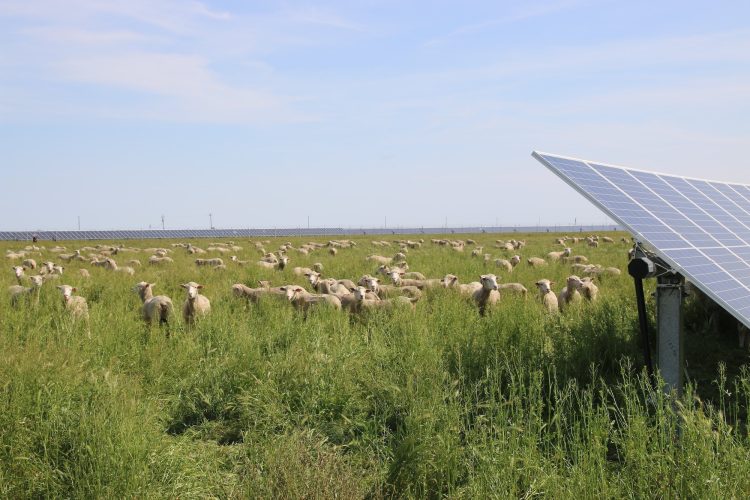
After more than a century of decline, the number of sheep in the United States is slowly ticking upward. With those growing populations comes the newly emerging industry of solar grazing, in which sheep are put to work trimming vegetation around solar panels. Beyond creating a new revenue stream for sheep farmers, solar grazing has the potential to contribute more waste wool to the sustainable building industry, among other sectors.
The decline and rise of the U.S. sheep industry
The revival of the U.S. wool industry comes after a long period of decline. The first national sheep inventory was taken in 1867, registering 45 million head. The number peaked at 51 million in 1884, but after decades of diminishment, it settled at less than 5 million in 2016.
More recently, herds are growing in numbers again. As of January 1, 2025, the U.S. Department of Agriculture registered 5.05 million head of sheep and lamb on U.S. farms, an increase from 5.03 million head a year earlier.
Historically sheep in the U.S. have been raised more for their wool than their meat, according to the USDA, but that may be changing. In some regions, ethnic preferences for lamb and mutton are supporting the growth in herds, even as the market for wool has been shrinking, reports the trade publication American Farm.
“Virginia’s sheep and lamb inventory grew 1 percent from 79,000 head in 2024 to 80,000 head in 2025,” the outlet’s Delmarva bureau (covering Delaware, Maryland and Virginia) reported. “Meanwhile, the value of Virginia wool decreased by 34 percent from 2023 to 2024.”
The cost of shearing, cleaning, and spinning wool to produce high-quality yarn works against the wool market in the U.S., amplified by a growing shortage of experienced sheep shearers. Consumer preference for lower-cost, easy-care fabrics is another factor, along with the more general issue of competition from overseas garment manufacturers and other textile makers.
Lee Wright, superintendent and senior research associate at the Southwest Virginia Agricultural Research Station, told American Farmer that herd increases in Virginia mainly involve breeds of sheep that grow more hair than wool — presenting another obstacle to growth in the U.S. wool market. All sheep have a mix of hair and wool, but “hair sheep” are considered easier to maintain, particularly for small-scale and beginning farmers whose priority is the lamb and mutton market. Among other advantages, hair sheep do not require shearing because their coats naturally shed.
Solar grazing and sustainable materials
Despite these limitations, solar grazing has the potential to support U.S. wool production by providing sheep farmers with additional revenue and grazing opportunities.
Solar grazing is a branch of the agrivoltaic movement, in which solar arrays are designed with enough space for farming activities between the rows of solar panels. Although the agrivoltaic field is relatively new, by 2022 solar developers typically paid sheep farmers $200 to $300 per acre to manage vegetation in solar arrays.
Solar grazing is even prompting some farmers to change business models. In March, for example, the news organization Ag Daily covered a cotton farmer who switched gears to concentrate on solar grazing. A cotton crop raised in 2024 would have brought on a loss of $200,000. Instead, the farmer recorded a $300,000 profit through the combined revenue from solar grazing and sales of lamb meat.
“Sheep-herding for solar is one of the ways these farmers are scrambling to diversify their income, as a multi-year slump in the U.S. agricultural economy has hit crop producers particularly hard,” Ag Daily reported.
Helping to push the movement forward from the private-sector side is the trade organization American Solar Grazing Association. Among other activities, starting last year the Association has partnered with the American Lamb Board and the independent power producer Urban Grid on solar grazing workshops for farmers.
“These grazing workshops have been successful in helping producers across the country learn about opportunities to graze sheep on solar projects as a way to increase herd size and maximize profitability,” American Lamb Board Chairman Jeff Ebert said in a statement in August.
The many uses of sheep’s wool
Many kinds of livestock can be grazed within an agrivoltaic array, but sheep are generally preferred due in part to their grazing efficiency.
Because agrivoltaics is a new science, knowledge gaps remain. However, researchers are beginning to assemble evidence supporting the benefits of solar grazing for sheep health and sheep’s wool. The panels contribute to moisture retention in the soil that helps raise the quality of forage. Researchers see evidence of improved digestibility, which also helps to reduce greenhouse gas emissions compared to sheep foraging in non-solar pastures.
The big question is how to build new markets for wool outside of the textile industry. Because wool retains moisture and adds nutrients to soil as it decomposes, interest in deploying wool as a soil enhancer is growing. Last year, for example, soil experts at the University of South Dakota noted that wool naturally consists of the common fertilizer ingredient nitrogen, along with sulfur, phosphorus and potassium, making it well-suited as a soil additive.
Waste wool is also emerging as an alternative material for soundproofing buildings. “Contrary to other raw materials used for the production of soundproofing materials, wool is renewable, biodegradable and naturally fire resistant,” a research team based in Europe noted in 2022.
That’s not the only way wool is being used for buildings. For example, in June the U.K. startup Wull Technologies earned a grant to bring its wool-based insulation panels to market. Closer to home, last week the Nevada firm Havelock Wool announced a new retail sales partnership with The Home Depot, making the company’s wool insulation products available to consumers nationwide.
The use of waste wool for insulated shipping packages is also beginning to scale, particularly in regions where excess wool waste is readily available. Examples include the Estonian firm Woola, the Australian firm Planet Protector, and the U.K. firms Hydropac and WoolCool.
As for the U.S. market, that will depend on the direction the domestic sheep farming industry goes, potentially with an assist from the solar grazing movement alongside rising demand for lamb and mutton. Havelock is one potential customer, though the company currently imports waste wool from New Zealand, where the quality of the wool fits its needs and the population of sheep rests at 23.6 million head, far surpassing the U.S. at a fraction of the land mass.
Image credits: AgriSolar Clearinghouse/Flickr, WoolCool and Manchester Press Photography Ltd



Post Comment