The Climate Potential of Brewing With Bread
Welcome to 3p Happy Hour! As we all eye the exit door on Friday afternoons, we’re raising our glasses to the sustainable wine, beer and spirits brands serving up stiff sips with less environmental impact while benefiting communities.
Breaking bread is one of our most cherished traditions, yet we still toss it out by the basketful. We send millions of tons of bread to landfills every year, squandering valuable water, land and money used to create it while food production and waste accounts for up to a third of global greenhouse gas emissions.
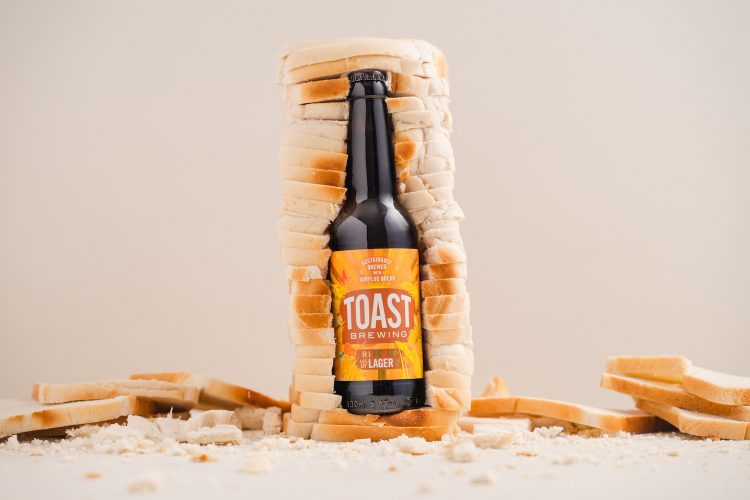
But what if one man’s garbage is another man’s malt? Liquid bread is taking on a whole new meaning with brewers and distillers reusing loaves, pastries and croissants in their products. One United Kingdom-based operation, Toast Brewing, is taking this to the next level by incorporating surplus bread into all of its brews. So far, it spared over 4.1 million slices from the landfill, transforming them into tipples like Rise Up Lager, Jason’s Sourdough IPA and Grassroots Pale Ale. Plus, the brewery donates all of the profits to charity, proving that you can have your ciabatta ale and drink it too.
Bread-brewed beer
Toast Brewing was founded in 2016 to address an all too common problem: food waste. The average U.K. resident buys about 60 loaves of bread per year, but much of that ends up in the trash since bread spoils quickly.
“We waste a huge amount of bread,” said Louisa Ziane, chief operating officer and co-founder of Toast Brewing. “There are currently 20 million slices every single day that are wasted in U.K. households. That is just the homes.”
Waste is also produced during bread’s production and sale. “In the U.K., we have a lot of prepackaged sandwiches sold by retailers, hospitality, et cetera,” Ziane said. “There’s an industry that essentially purchases loaves and uses the bread to produce those sandwiches. They are discarding the end slice of every single loaf and sometimes some of the other slices, as well, if they’re bashed or they’re not quite the full size of the loaf.”
Toast Brewing intervenes to salvage this surplus bread from bakeries and sandwich makers. To incorporate it into its brews, the bread is dried and turned into crumbs. The crumbs replace about 25 percent of the barley, the main grain in beer, that would otherwise be used. Adding more bread than that can negatively impact the beer’s flavor due to high salt levels.
From crumb to can
Bread may be an unusual ingredient in beer, but this bakery-infused brewing process is advantageous because it reduces the amount of grain used in brewing on top of eliminating food waste. Because of that, research has found that every kilogram of bread turned into beer saves nearly half a kilogram of carbon dioxide emissions. While beer’s largest source of carbon emissions comes from packaging, raw materials are the next largest.
To make beer, barley is malted, a process involving wetting and drying the grains. This allows the grain’s starch to be converted to sugar, which yeast uses for fermentation. But the process uses a lot of water and heat energy.
“Most brewers, if they’re heavily in packaged beers — glasses and cans — that is likely where a big part of their carbon footprint will be,” Ziane said. “The second biggest area then is malt, because there’s a lot of emissions involved in the agricultural stage, often to do with fertilizers and pesticides that are used by the farmers.”
Swapping out some barley could be beneficial for climate change adaptation, too. It is best grown in temperate climates, putting the crop at risk under rising global temperatures. While production can be shifted north, many countries could be forced to import more barley under a hotter future.
Given all these benefits, Toast Brewing has worked to spread the knowledge of bread brewing. “We open-sourced the recipes,” Zian said. “There is a recipe on our website that people can access that’s mostly used at the homebrew scale. We’ve done over 100 collaborations, mostly in the U.K., but all around the world, as well. And we have inspired other breweries to set up either as bread beer breweries or to add a product to their standard range.”
The brewery also donates all of its profits to environmental charities such as Feedback, Soil Heroes Foundation, Rainforest Trust U.K. and Plantlife, along with giving its spent grain to farmers as livestock feed.
Complexities of the craft
Despite the boons of this bread-to-barley swap, it’s not all smooth sipping. Toast Brewing has to collect, process and verify the bread’s nutritional profile, since this can affect the resulting beer. Because of these steps, it can be challenging to run a cost-effective operation.
“Quite often people assume that because we’re using bread, it should be cheaper,” Ziane said. “But actually it’s probably comparable to malted barley because of all of the additional stages that we have to go through with the more unusual ingredient.”
Another hurdle involves the brewing process itself and the containers, called mash tuns, where the grains and water are mixed together. The process results in a porridge-like substance, or mash, which is eventually separated into leftover grains and liquid.
“You can get a stuck mash where the bread essentially clogs the mash tun, and then it reduces the efficiency of the brew,” Ziane said. “And you can get out less of the wort, which is the sugary liquid at the first stage of brewing, that then goes on to be the beer. Obviously, that then affects the economics of the batch.”
To avoid this, the brewery adds rice husks to the mash, allowing the sugary wort to flow more easily, Ziane said.
Another challenge is overcoming preconceived ideas about their beer’s taste. “A lot of the work we’ve done is about getting people to taste it and realize you probably can’t taste bread at all,” Ziane said. “The bread is just adding the sugars, which have fermented. Then you get a lot of flavors from the malt, and you get a lot of flavors obviously from the hops as well, even the most. But you won’t taste bread within the beer.”
Beer is the most widely consumed alcoholic drink, while bread is one of the most wasted foods. Joining these two together was an ingenious match rooted in ancient traditions. Plus, it fulfills consumers’ growing desire for sustainability.
“Over the past 10 years, since we started, we were seen almost as a novelty product by consumers and the industry,” Ziane said. “Over time, we’ve been accepted by both, as people have also become much more familiar with the concept of the circular economy, and people don’t like waste. I think we’ve got to a point now where people get it.”


Post Comment